



By Corey Arvin, Staff Writer
2014 Annual Inland Empire Survey reveals surprising optimism for civic leadership
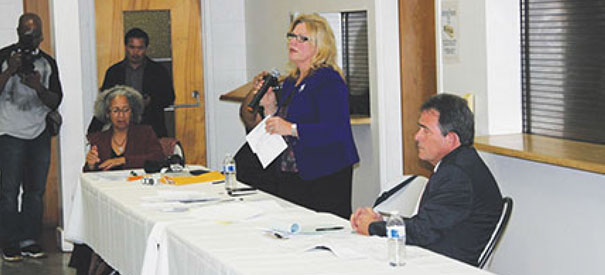
San Bernardino, the vast anchor and namesake of the county, earned several distinctions in recent years that began to chip away at its already fragile relationship with residents. Its Chapter 9 bankruptcy filing was only the beginning of its descension, as the divisive City Council – and the alleged illegal activities of two council members – became the tipping point for residents who said they were exhausted with the political strife in their city.
The city’s woes ultimately led to voters replacing City Attorney Jim Penman and City Councilwoman Wendy McCammack with Gary Saenz and James Mulvihill respectively. Councilman Chas Kelley, accused of personally using campaign funds, resigned. Both Saenz and Mulvihill were fresh faces to city government unlike their predecessors, which was exactly what organizers of concerned citizen’s group San Bernardino Residents for Responsible Government intended when it began a recall campaign in May, garnering enormous community support before elections.
Less than one year later, San Bernardino officials’ tarnished images appear to be improving based on the results of the 2014 Annual Inland Empire Survey, released July 17. The survey, compiled by the Institute of Applied Research at Cal State San Bernardino (CSUSB) was sponsored by the university and Mojave Water Agency, which measured 923 residences responses on local matters.
According to the survey, about 57 percent of respondents reported having a “great deal” or “some” confidence in their elected officials county-wide. For the city of San Bernardino, that figure was slightly lower at 51 percent, but a substantial increase from last year’s 39 percent. Respondents’ views on the local economy fared significantly lower, similar to the previous year’s survey. Only 17 percent of respondents considered San Bernardino County’s economy “excellent” or “good”.
Scott Beard, who spearheaded the recall that would have ousted most of the city council, considered the survey’s findings a welcome gauge of how San Bernardino officials are managing the city’s affairs. The increase to 51 percent of respondents having confidence in local leadership is a modest, but significant improvement, he said.
“I think the new leadership is a lot more transparent than the old leadership. That makes a difference in the eyes of people,” he said.
Mayor Davis and the City Council are focusing their attention on the economy, which is an important leap forward for the city, said Beard.
“We got a budget passed for the first time in a long time without any gimmicks, a police chief hired from the ranks, we have a coordinated effort … it’s just an overall better attitude,” said Beard.
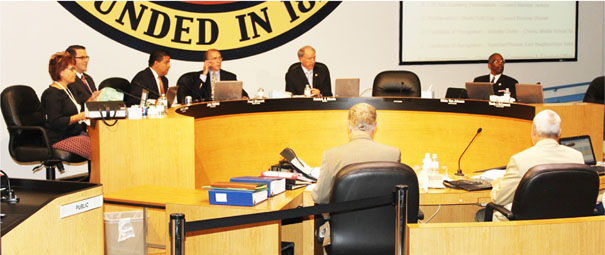
Following the survey’s release last week, to address economic sustainability and public safety concerns, Mayor Carey Davis’ roadmap for the city was reviewed by the City Council, which would give the city a clear plan for what its priorities would be moving forward. The plan addresses a number of areas already covered in the annual survey.
“I think that it is an excellent framework. In the 15 years I have been (in San Bernardino), there hasn’t been a blueprint [for the economy] approved by this entire council,” he said.
However, Beard noted there is still more work to be done to revitalize San Bernardino.
“It took 25 years for the city to get in the toilet, it is going to take some time to get out,” said Beard.
According to Barbara Sirotnik, PhD, a CSUSB professor and author of the survey, the data collection and compiling of the report took several weeks to complete. Though labeled the “Inland Empire” survey, this year’s survey did not include responses from Riverside County because it did not have an additional sponsor, said Sirotnik.
Sirotnik said the 2014 survey revealed several interesting findings, “if not surprising.”
“Regardless of San Bernardino County’s bad reputation, nearly two-thirds of respondents rate the county as a ‘very good’ or ‘fairly good’ place to live. I always find that interesting,” said Sirotnik.
Additional “interesting” results from the survey were the estimated $7,320 cost of commuting for county residents. The survey also indicated even though violent crime in the county is lower, the fear of crime has not decreased accordingly, she said.
Sirotnik and Beard both considered the survey a valuable tool that could help officials understand the concerns of the community. Beard said the survey can provide more insight than officials are accustomed to receiving from smaller groups of people who attend city council meetings, for example.
“It is absolutely an important resource. That’s why we have people sponsoring the survey year after year. The survey offers the unique ability for businesses and public agencies who sponsor the survey to include proprietary questions which will allow them to gain insights into what residents are thinking. Simply put, it provides decision makers with data invaluable for making informed decisions,” said Sirotnik.
“(The survey) also gives residents a ‘voice’ regarding issues such as county services, transportation issues, and ballot measures. Further, it is a valuable tool for government agencies to gain public input regarding quality of life issues and to identify some of the challenges county residents face. And the evaluations of various government services serve as one way of improving government management through accountability. It is an important venue for community engagement.”
To review the 2014 Annual Inland Empire Survey in full and an archive of previous surveys, visit http://iar.csusb.edu/reports/ie_annual_survey.html.